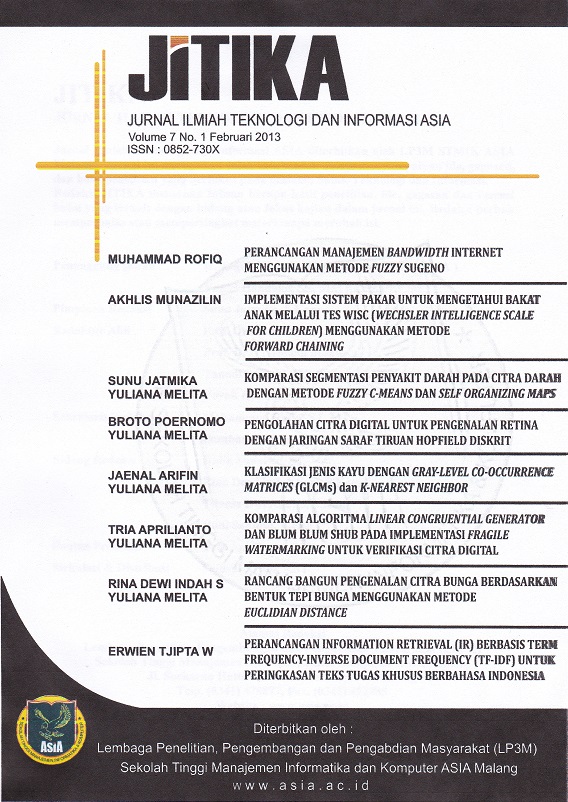
Komparasi Algoritma Linier Congruential Generator Dan Blum Blum Shub Pada Implementasi Fragile Watermarking Untuk Verivikasi Citra Digital
Article Sidebar
Main Article Content
Abstract
Fragile watermarking merupakan salah satu aplikasi steganografi yang dapat menjadi solusi kebutuhan verifikasi citra digital. Metode yang digunakan untuk teknik watermarking ini adalah metode Least Significant Bit (LSB). Metode LSB ini mengganti bit-bit yang tergolong bit LSB pada setiap byte pada suatu piksel citra dengan bit-bit watermark yang akan disisipkan.
Untuk memperkuat teknik penyembunyian data, bit-bit watermark tidak digunakan mengganti bit-bit dari piksel awal sampai piksel terakhir secara berurutan, namun dipilih susunan piksel secara acak.. Hal ini dapat dilakukan dengan memanfaatkan algoritma Linear Congruential Generator (LCG) dan Blum Blum Shub (BBS) sebagai pembangkit bilangan acak semu (Pseudo Random Number Generator / PRNG). Bilangan acak yang dihasilkan akan digunakan sebagai posisipiksel sebagai tempat penyisipan watermark.
Penelitian ini dilakukan dengan membuat aplikasi fragile watermarking dan kemudian membandingkan histogram, nilai Mean Squared Error (MSE) dan Peak Signal to Noise Ratio (PSNR) dari setiap hasil penyisipan watermark (embedding) yang dilakukan. Aplikasi dibuat dengan menggunakan bahasa pemrograman Visual Basic 6.0.
Downloads
Article Details

This work is licensed under a Creative Commons Attribution 4.0 International License.
Authors retain copyright of their work and grant Jurnal Ilmiah Teknologi Informasi Asia the right of first publication. The work is simultaneously licensed under a Creative Commons Attribution 4.0 International License (CC BY 4.0) that allows others to share the work with an acknowledgment of the work's authorship and initial publication in this journal.
While the editorial board endeavors to ensure accuracy, they accept no responsibility for the content of articles. Liability rests solely with the respective authors.
This is an open-access journal. All articles are immediately available to read and reuse upon publication under the CC BY 4.0 license. Users may share and adapt the material for any purpose, including commercial use, provided they comply with the license terms.