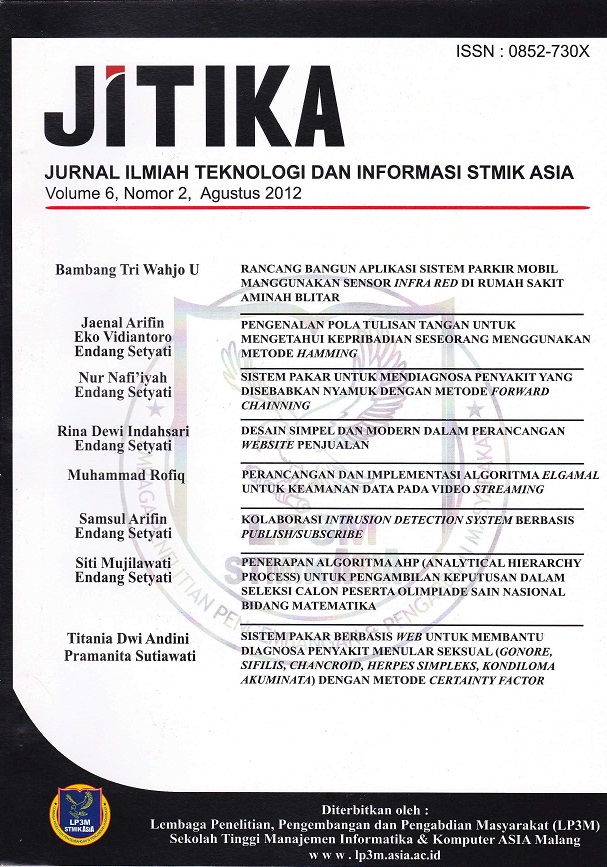
Perancangan dan Implementasi Algoritma Elgamal untuk Keamanan Data pada Video Streaming
Article Sidebar
Main Article Content
Abstract
In particular streaming video application requires a data security requires all users can not know the contents of the data. Some examples of video streaming applications that require confidentiality of data between other video applications on demand, pay per view programs, and video conferencing applications. In the process of encryption of data, especially multimedia data, there are two things to note. First, the size of multimedia data is usually very large, and second, multimedia data must be processed in real-time.
In the design and implementation of streaming video encryption method is developed using the ElGamal algorithm. It is intended for application development on the basis of the block cipher algorithm in a stream-based applications. Generally, stream-based encryption has its own algorithm based stream ciphers and block ciphers such as Video Encryption Algorithm (VEA), CR4, DES or AES, and others. In the design and implementation through several stages, frame capture, frame encryption and streaming process on the server side, while on the client side do the data retrieval process stream, decrypt the data, and display it as a video output.
The results show the accuracy of the video data (frame) to 100%. Time delay in the video frame encryption standard (MPEG) of 0.775 seconds and 1.027 seconds for decryption. Time delay on the webcam frame encryption standard (640x480) by 1.797 seconds and 2.860 seconds for decryption. Entropy values for the standard video frame of 7.680 and 7.595 of a standard webcam. Average bandwidth required for video streaming applications for 55.1 kbps.
Keywords: Video Streaming, ElGamal, Encryption, Decryption
Downloads
Article Details
Authors retain copyright of their work and grant Jurnal Ilmiah Teknologi Informasi Asia the right of first publication. The work is simultaneously licensed under a Creative Commons Attribution 4.0 International License (CC BY 4.0) that allows others to share the work with an acknowledgment of the work's authorship and initial publication in this journal.
While the editorial board endeavors to ensure accuracy, they accept no responsibility for the content of articles. Liability rests solely with the respective authors.
This is an open-access journal. All articles are immediately available to read and reuse upon publication under the CC BY 4.0 license. Users may share and adapt the material for any purpose, including commercial use, provided they comply with the license terms.